>>Annexin V-AbFluor™ 488 Apoptosis Detection Kit | 貨號KTA0002

| 代理廠牌: |  |
| 原廠連結: | |
| 相關下載: |
Annexin V-AbFluor™ 488 Apoptosis Detection Kit | 貨號KTA0002
Introduction to Annexin V
Annexin V 細胞凋亡偵測原理
Annexin V細胞染色,用於檢測細胞凋亡早期的細胞膜變化。在細胞凋亡早期,膜磷脂醯絲氨酸phosphatidylserine (PS)由脂膜內側翻向外側。Annexin V是一種鈣離子依賴性磷脂結合蛋白(calcium ion-dependent phospholipid binding protein ),分子量為35~36KDa,可與PS磷脂醯絲氨酸(phosphatidylserine , PS)特異性結合,親和力高。 在正常細胞中,磷脂醯絲氨酸(phosphatidylserine , PS)僅分佈在細胞膜脂(lipid bilayer )雙層的內側。 在細胞凋亡(apoptosis)的早期階段,膜磷脂醯絲氨酸(membrane phosphatidylserine, PS)從脂質膜( lipid membrane)的內側轉向外側。 作為一種磷脂結合蛋白(phospholipid binding protein),Annexin V 與磷脂醯絲氨酸(phosphatidylserine , PS)具有高親和力。 它通過暴露在細胞外的磷脂醯絲氨酸(phosphatidylserine , PS)與細胞凋亡早期的細胞膜結合。 因此,Annexin V 是檢測早期細胞凋亡的敏感指標。用綠色螢光FITC標記的Annexin V通過流式細胞儀或螢光顯微鏡可以檢測到細胞凋亡的發生。結合細胞核染劑PI,利用流式細胞儀或螢光顯微鏡可偵測偵測細胞凋亡現象及其凋亡分期。碘化丙啶(Propidium Iodide, PI)是一種核酸染料,PI只能透過凋亡晚期和死細胞的細胞膜,Annexin V和PI結合使用,可以區分凋亡早晚期的細胞及死細胞。

Fig.1. Hela cells were induced with camptothecin for 24 hours and stained with Annexin V- AbFluor™ 488/PI Apoptosis Detection Kit. The cell is a late stage apoptotic/necrotic cell with both Annexin V- AbFluor™ 488 and PI staining (green membrane with red fragmented nucleus).

Fig.2. Hela cells were induced with camptothecin for 24 hours and stained with Annexin V- AbFluor™ 488 Apoptosis Detection Kit. The combination of AbFluor™ 488 and propidium iodide allows for the distinction between early apoptotic cells (Annexin V- AbFluor™ 488 positive), late apoptotic and/or necrotic cells (Annexin V- AbFluor™ 488 and propidium iodide positive), and viable cells (unstained).

Fig.3. Hela細胞用4種不同濃度(0、1:8000、1:4000、1:2000、1:1000)的Camptothecin誘導24小時,並用Annexin V-AbFluor™ 488 /PI凋亡檢測試劑盒( Annexin V- AbFluor™ 488 /PI Apoptosis Detection Kit)染色。 AbFluor™ 488 和PI 碘化丙啶的組合可以區分早期凋亡細胞(Annexin V-AbFluor™ 488 陽性)、晚期凋亡和/或壞死細胞(Annexin V-AbFluor™ 488 和碘化丙啶陽性)和活細胞(未染色)。
Specification
| Product name | Annexin V-AbFluor™ 488/PI Apoptosis Detection kit |
| Applications notes | Abbkine Annexin V-AbFluor™ 488/PI Apoptosis Detection kit contains Annexin V labeled with Abbkine proprietary green fluorescent dye AbFluor™ 488, which allows the identification and quantitation of apoptotic cells by flow cytometry or fluorescence microscopy. Simultaneous staining of cells with AbFluor™ 488 and propidium iodide (PI) allows the discrimination of intact cells, early apoptotic and late apoptotic or necrotic cells. |
| Alternative | Annexin 5; Annexin V; AbFluor™ 488 |
Product Properties
| Kit components | • Annexin V Binding Buffer (5×) • Annexin V-AbFluor™ 488 • Propidium Iodide (PI) • Apoptosis Inducer A •Apoptosis Inducer B |
| Features & Benefits | • Abbkine AbFluor™ 488 dye is superior to FITC as it is brighter, not affected by pH, and has much better photostability • Annexin V- AbFluor™ 488: Abs/Em = 491/517 nm; PI: Abs/Em = 535/617 nm (with DNA) • Suitable for flow cytometry or fluorescence microscopy |
| Storage instructions | Stable for at least 12 months at -20°C from date of shipment. Protect from light. |
| Shipping | Blue ice |
| Precautions | The product listed herein is for research use only and is not intended for use in human or clinical diagnosis. Suggested applications of our products are not recommendations to use our products in violation of any patent or as a license. We cannot be responsible for patent infringements or other violations that may occur with the use of this product. |
Additional Information
| Background | Apoptosis is a form of programmed cell death to remove unwanted, damaged, or senescent cells from tissues. In normal cells, the negative phospholipids reside on the inner side of the cellular membrane while the outer surface of the membrane is occupied by uncharged phospholipids (PS). After a cell has entered apoptosis, the negatively charged PS are transported from the inner to the outer leaflet of the plasma membrane, thus exposing PS to the external cellular environment. The human anticoagulant, Annexin V, is a 35–36 kDa Ca2+-dependent phospholipid-binding protein that has a high affinity for PS. Annexin V labeled with a fluorophore or biotin can identify apoptotic cells by binding to PS exposed on the outer leaflet. Propidium iodide (PI) is a membrane-impermeant DNA-binding dye that is commonly used to selectively stain dead cells in a cell population. PI is excluded by live cells and early apoptotic cells, but stains necrotic and late apoptotic cells with compromised membrane integrity. PI can be excited by the 488, 532, or 546 nm laser lines, and emits red fluorescence. |
| Alternative | Annexin 5; Annexin V; AbFluor™ 488 |

Annexin V is a calcium ion-dependent phospholipid binding protein with a molecular weight of 35~36KDa, which can specifically bind to phosphatidylserine PS with high affinity. In normal cells, phosphatidylserine is only distributed on the inner side of the lipid bilayer of the cell membrane. In the early stage of cell apoptosis, the membrane phosphatidylserine (PS) turns from the inner side of the lipid membrane to the outer side. As a phospholipid binding protein, Annexin V has a high affinity with phosphatidylserine. It binds to the cell membrane of cells in the early stage of apoptosis through the phosphatidylserine exposed on the outside of the cell. Therefore, Annexin V is a sensitive indicator for detecting early cell apoptosis.
Product information
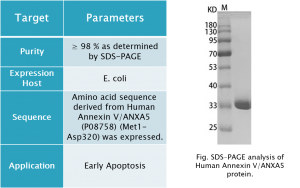
Demonstration of the experiment results
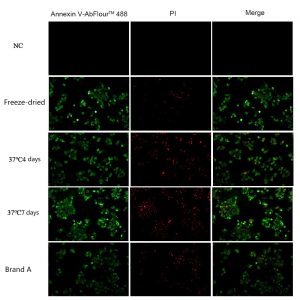
Fig. Abbkine lyophilized annexin V protein, lyophilized at 37°C for 4 days, 37°C for 7 days, and A brand annexin V protein, are respectively labeled with AbFluor488 fluorescent dye for apoptosis staining using LinKine™ AbFluor™ 488 Labeling Kit (abbkine, KTL0520-10k) . Hela cells were treated with Biyuntian Cell Apoptosis Positive Control Kit (C0005, 1:1000 dilution) for 24 hours, then stained and observed by fluorescence microscope.
Related product information
| Product Name | Item No. |
| Terminal Deoxynucleotidyl Transferase (TdT) | PRP3002 |
| TUNEL Apoptosis Detection Kit (Orange Fluorescence) | KTA2011 |
| TUNEL Apoptosis Detection Kit (Green Fluorescence) | KTA2010 |
| Annexin V-AbFluor™ 488 Apoptosis Detection Kit | KTA0002 |
| Annexin V-AbFluor™ 555 Apoptosis Detection kit | KTA0003 |

Human FGF1/FGF acidic protein重組蛋白 |貨號PRP1001
Introduction to FGF21
FGF21 是成纖維細胞生長因子 (Fibroblast Growth Factor , FGFs) 家族的成員。 該家族的蛋白質具有廣泛的促有絲分裂(mitogenic )和細胞存活活性( cell survival activities),並參與多種生物過程,如血管生成(angiogenesis)、傷口癒合(wound healing)、神經發育(neurodevelopment)和腫瘤( tumor occurrence )的發生。 大多數 FGF(FGF3-8、10、15、17-19、21-23)在 N 端具有典型的信號序列分泌蛋白(signal sequence secreted proteins)。 其中,成纖維細胞生長因子21(Fibroblast Growth Factor 21 , FGF 21)在肝臟特異性表達,通過脂肪組織和胰腺範圍降低血糖和甘油三酯(triacylglycerols)。 胰高血糖素(Glucagon )可改善胰島 B 細胞(pancreatic islet B cells)的功能,從而防止飲食引起的肥胖(diet-induced obesity )和胰島素抵抗(insulin resistance.)。 此外,FGF21 還被證明是一種主要的 5-羥色胺(serotonin)的內源性調節因子,在禁食和酮症(ketosis)中起關鍵作用。
FGF21 is a member of the Fibroblast Growth Factor (FGFs) family. The proteins of this family have a wide range of mitogenic and cell survival activities, and are involved in a variety of biological processes, such as angiogenesis, wound healing, neurodevelopment, and tumor occurrence and development. Most FGFs (FGF3-8, 10, 15, 17-19, 21-23) have typical signal sequence secreted proteins at the N-terminus. Among them, Fibroblast Growth Factor 21 (FGF 21) is specific in the liver Sexual expression, reducing blood sugar and triacylglycerols through the scope of adipose tissue and pancreas. Glucagon improves the function of pancreatic islet B cells, thereby preventing diet-induced obesity and insulin resistance. In addition, FGF21 has also been shown to be a major The endogenous regulatory factors of serotonin play a key role in fasting and ketosis.
Product information
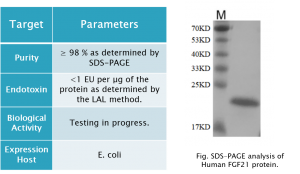
Related product information
| Product Name | Item No. |
| Human FGF1/FGF acidic protein | PRP1001 |
| Human bFGF protein | PRP1010 |
| Mouse bFGF protein | PRP1011 |
| Rat bFGF protein | PRP1210 |
sRANKL重組蛋白 |Mouse RANKL protein 貨號PRP1114
Introduction to sRANKL
腫瘤壞死因子配體超家族成員 11(Tumor necrosis factor ligand superfamily member 11),也稱為核因子受體激活劑 kappa-B 配體(nuclear factor receptor activator kappa-B ligand)、骨保護素配體(osteoprotegerin ligand)、TNFSF11、RANKL、TRANCE、OPGL 和 CD254,在多種細胞中表達,包括成骨細胞(osteogenic Cells)、成纖維細胞(fibroblasts)、活化的 T 細胞(activated T cells )和 骨髓基質細胞(bone marrow stromal cells )可以與誘餌受體 OPG (decoy receptor OPG)相互作用。 TNFSF11參與了許多基本的生物學過程,如調節T細胞與樹突狀細胞之間的相互作用、調節T細胞依賴性免疫反應以及增強惡性腫瘤體液高鈣血症中的骨吸收(bone resorption)。 TNFSF11還增強了樹突狀細胞刺激T細胞(Naive T cells)增殖的能力。
Tumor necrosis factor ligand superfamily member 11, also known as nuclear factor receptor activator kappa-B ligand, osteoprotegerin ligand, TNFSF11, RANKL, TRANCE, OPGL and CD254, expressed in a variety of cells, including osteogenic Cells, fibroblasts, activated T cells and bone marrow stromal cells can interact with the decoy receptor OPG. TNFSF11 participates in many basic biological processes, such as regulating the interaction between T cells and dendritic cells, regulating T cell-dependent immune responses and enhancing bone resorption in humoral hypercalcemia of malignant tumors. TNFSF11 also enhanced the ability of dendritic cells to stimulate the proliferation of naive T cells.
Product information
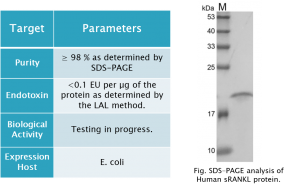
Related product information
| Product Name | Item No. |
| Mouse RANKL protein | PRP1114 |

Abbkine建立了完整的蛋白表達平台,注重培養專業、優秀的技術人才。 先後開發了數百種優質重組蛋白產品,建立了一套完整的生產、質量控制和活性評價體系。 spot的種類越來越多。 目前,這些重組蛋白產品可用於人、小鼠、大鼠等物種的生物學研究,涵蓋免疫學、神經生物學、幹細胞研究、癌症研究等多個研究方向。
| Type | Related Products |
| Cytokines | Interleukin, tumor necrosis factor, growth factor, chemokine,Interferon, colony stimulating factor |
| Immune checkpoint | PD-1、PD-L1 |
| Target protein | CD38、CD20 |
| CD antigen | CD86、CD80、CD19、CD7/GP40、CD22 |
| Other recombinant proteins | LPT, TRAIL, LIF, etc. |


| 產品貨號 | 品項 | 反應 | 測量儀器 |
| 貨號KTA1001 | 活細胞和死細胞雙染色試劑盒 | 100個反應 |
活細胞綠色螢光染劑Ex/Em = 488/530 nm; 死細胞紅色螢光染料(Ex/Em = 535/617) |
|
|
|
50個反應 | 螢光酶標儀、螢光顯微鏡或流式細胞儀。FITC通道(Ex / Em = 490nm / 520 nm) |
|
|
CCK-8細胞增殖和細胞毒性試劑盒 | 500個反應 | 吸收光450nm |
| 貨號KTC4003 | TraKine™粒線體染色 | 50個反應/250個反應 | Ex / Em = 490/523 nm增殖(proliferating)和非增殖細胞(non-proliferating cells) |
| 貨號KTC4100 | Pro活細胞微管蛋白染色 | 50個反應/250個反應 | Ex/Em = 500/520 nm |
| 貨號KTC4001 | Abbkine 細胞膜染色 | 100個反應/500個反應 | Ex/Em = 484/501 nm |
| 貨號BMD00063 | DAPI Staining Solution | 10MG/100MG | Ex/Em: 358/461 nm (with DNA) |
| 貨號KTC4210 | 活細胞Lysosome染色 | 50個反應/250個反應 | deep red fluorescent dye , Ex/Em:650/665nm |
| 貨號KTA3030 | 細胞衰老檢測試劑盒(β-半乳糖苷酶) | 100個反應 | 光學顯微鏡 |
| 貨號KTA1020 | CCK-8細胞增殖和細胞毒性試劑盒 | 1000個反應/10,000個反應 | 吸收光450nm |
| 貨號KTA2030 |
(BrdU替代法) |
100個反應/500個反應 | AbFluor 488 azide (Ex/Em = 501/525 nm) |
| 貨號KTB1400 | 一氧化Dan(NO)檢測試劑盒 |
96個反應/ 192個反應 |
colorimetric (540 nm) 檢測範圍:1-100 µM |
| 貨號KTB1070 | CheKine™黃嘌呤氧化酶檢測 |
96個反應/ 480個反應 |
OD 450 nm 線性範圍15.6 -500 mU/ |
| 貨號KTD3001 | BCA蛋白定量試劑盒 |
2000個反應/ 5000個反應 |
OD 562 nm 相容性 5 % SDS, 5 % Triton X-100, 5 % Tween-20, 60, 80 50 to 1000 µg/ml. |
| 貨號KTB1110 | 乳酸脫氫酶(LDH)測定試劑盒 |
96個反應/ 480個反應 |
λmax= 450 nm 1- 20 U/mL of LDH |
| 貨號PRP100153 | IGF-I重組蛋白 | 200UG/1MG |
human IGF1 isoform 1 (P05019-1) (Gly 49-Ala 118) > 95 % as determined by SDS-PAGE |
| 貨號 KTA2020 | 細胞週期染色檢測 | 100個反應/500個反應 | Ex/Em=535/615 nm. |
| 貨號BMC21400 | PurKine™內毒素去除預裝離心柱 |
1ml×5 3mlx5 |
More than 2,000,000 EU/mL to eliminate >99% of endotoxins. |
| 貨號KTA1200 | CheKine™蛋白羰基比色測定試劑盒 |
48個反應/ 96個反應 |
吸收光370 nm |
| 貨號KTB1080 | 超氧陰離子清除測定試劑盒 |
48個反應/ 96個反應 |
Superoxide anion scavenging rate D% =(∆∆ODControl – ∆∆ODSample)÷ ∆∆ODControl ×100% |
| 貨號KTB1090 | 清除氫氧自由基能力測定試劑 |
48個反應/ 96個反應 |
吸收光 536nm Hydroxyl radical scavenging rate D% =(ASample – AControl)÷(ABlank – AControl)×100% |
| 貨號KTB2220 | TC總膽固醇檢測試劑盒 |
48個反應/ 96個反應 |
500nm Standard: 5 μmol/mL |
| 貨號KTB1510 | CheKine™尿酸(UA)比色分析試劑盒 |
48個反應/ 96個反應 |
吸收光505 nm Standard: 5 μmol/mL. |
| 貨號KTB1300 | Glucose葡萄糖測定試劑盒 |
96個反應/ 192個反應 |
吸光值630nm 4- 300 mg/dL) |
| 貨號KTB1100 | Lactate 乳酸檢測試劑盒 |
96個反應/ 480個反應 |
colorimetric (450 nm) 0.03 mM-2 mM |
| 貨號KTB1700 | 組織和血液鹼性磷酸酶( Alkaline Phosphatase, AKP / ALP)比色測定 |
96個反應/ 96 X5盤 |
吸收光510 nm |
| 貨號KTB1500 | 總抗氧化劑能力TAC分析 |
96個反應/ 480個反應 |
593 nm 偵測範圍: 0.15-3 mM |
| 貨號KTA0002 | Annexin V-AbFluor™488細胞凋亡檢測試劑盒 | 20個反應/50個反應/100個反應 | Annexin V- AbFluor™ 488: Abs/Em = 491/517 nm; PI: Abs/Em = 535/617 nm (with DNA) |
| 貨號KET7013 | EliKine™ Rat IL-6 ELISA Kit試劑盒 |
96個反應/ 96 X5盤 |
450 nm 偵測範圍: 250pg/mL-16000 pg/mL, 最低靈敏度100 pg/mL |
| 貨號KET0003 | 雌二醇(Estradiol , E2)試劑盒 |
96個反應/ 96 X5盤 |
450 nm 偵測範圍40 pg/ml-1500 pg/ml |
| 貨號KET6032 | TNF–α Alpha型腫瘤壞死因子 ELISA試劑盒 |
96個反應/ 96 X5盤 |
450 nm 7.8 pg/ml-500 pg/ml |
| 貨號KET6033 | VEGF血管內皮生長因子ELISA試劑盒 |
96個反應/ 96 X5盤 |
450 nm 偵測範圍: 31.25 pg/mL-2000 pg/mL |
| 貨號KET7005 | 白介素-1β(Interleukin-1β, IL-1β)ELISA試劑盒 |
96個反應/ 96 X5盤 |
Microplate reader capable of measuring absorbance at 450 nm, with the correction wavelength set at 540 nm or 570 nm. 偵測範圍: 15.6 pg/ml-1000 pg/ml |
| 貨號KTE70003 | 小鼠黃嘌呤脫氫酶/氧化酶(XDH)ELISA試劑盒 |
96個反應/ 96 X5盤 |
450 nm 偵測範圍: 22.5 ng/L-360 ng/L, 最低靈敏度1.0 ng/L。 |
| 貨號 A02051HRP | His-tag標籤多株抗體-HRP | 50ul/200ul | WB (1:5000). |
| 貨號A02170MGB | Anti-V5 Tag Mouse Monoclonal Antibody (11D5), 磁珠 | 100ul/400ul/2ml | GKPIPNPLLGLDST epitope |
| 貨號KTA4001 | JC-1線粒體膜電位測定試劑盒 |
100個反應/ 500個反應 |
(聚結的JC-1,Ex / Em = 585/590 nm)發出綠色螢光(JC-1單體,Ex / Em = 510/527 nm) JC-1 Stain CCCP (10 mM) Assay Buffer (5×) |
| 貨號KTB1600 | 穀胱甘肽(Glutathione)檢測 | 96個反應 |
412 nm 2-200 µg/mL |
| 貨號BMD00063 | DAPI Staining Solution | 1MG/10MG/100MG | λEx/λEm: 358/461 nm (with DNA) |
| 貨號KTP3001 | 細胞核/細胞質分離試劑盒 |
50個反應/ 200個反應 |
Cytoplasmic Solution A (CES A) Cytoplasmic Solution B (CES B) • Nuclear Extraction Solution (NES) DTT (500X) Protease Inhibitor (100X) |
| 貨號BMD00064-50UG | Calcein AM鈣黃綠素活細胞螢光染劑 | 50ug/1mg/10mg |
λEX/λEm: 494/517 nm (pH 8) (calcein)
|
| 貨號 KTB1660 | 硫氧還蛋白過氧化物酶(TPX)檢測 | 96個反應 | 240nm |
| 貨號KTB1020 | NAD/NADH 分析試劑盒 |
96個反應/ 480個反應 |
OD565 nm 96 孔板測定中的檢測限值為 0.78 μM 線性最高 50 μM NAD+/NADH。 |
| 貨號KTB1070 | CheKine™黃嘌呤氧化酶檢測 |
96個反應/ 480個反應 |
OD 450 nm 線性範圍15.6 -500 mU/mL |
| 貨號KTB1040 | Catalase過氧化氫酶活性檢測試劑盒 |
96個反應/ 480個反應 |
OD 540 nm 2-75 µM |
| 貨號KTB1060 | 過氧化物酶(Peroxidases)分析試劑盒 | 96個反應 |
OD 664 nm 線性範圍為15.6-1000 µU/mL |
| 貨號KTB1050 | 脂質過氧化檢測試劑盒(MDA) | 96個反應 |
OD 532 nm 1-100 µM/L |
| 貨號KTB1030 | 超氧化物歧化酶(SOD)活性測定試劑盒 | 96個反應 | 200-3.13 U/ml |
| 貨號KTA1030 | LDH細胞毒性測定試劑盒 |
96個反應/ 480個反應 |
OD 565 nm 10,00-100,0000 cells per well |