Hydroxyproline羥脯氨酸檢測試劑 | AkrivisBio貨號MA-0101

| 代理廠牌: | |
| 原廠連結: | |
| 相關下載: |
Hydroxyproline羥脯氨酸檢測試劑 | AkrivisBio貨號MA-0101
To measure 0.1-2 μg of hydroxyproline in samples
產品描述:羥脯氨酸(MW 131.13)是一種非必需氨基酸,主要存在於動物的膠原蛋白(collagen )和彈性蛋白(elastin)中。富含羥脯氨酸的蛋白質( Hydroxyproline-rich proteins)是也存在於植物細胞壁中,用作聚醣附著點。蛋白質中羥脯氨酸的其他情況是已知的,但相對罕見(HIF-1、芋螺毒素等)。羥脯氨酸是在合成後通過脯氨酰羥化酶在抗壞血酸依賴性過程中形成的肽鏈。它通過增強膠原蛋白的機械完整性來發揮作用。疾病狀態下的膠原蛋白形成和周轉,如肝纖維化(liver fibrosis)、佩吉特氏骨轉移(Paget’s, bone metastases)可以通過測量水解產物或血清和尿液羥脯氨酸(hydroxyproline)水平來評估。 AkrivisBio 的羥脯氨酸測定主要用於測量蛋白質和組織水解產物中的羥脯氨酸。血清和尿液可用作經過適當預處理後的樣品。 AkrivisBio 提供了一種測量羥脯氨酸的簡單方法,可產生色原測量範圍為 550-565 nm,適用範圍為 1-20 μg 膠原蛋白或約 0.1-2 μg 羥脯氨酸(hydroxyproline)。
Assay Principle:
1 – Samples are thoroughly hydrolyzed in acid
2 – Hydroxyproline is oxidized by Chloramine T to a pyrrole
3 – The pyrrole is subsequently reacted with Ehrlich’s Reagent to form a chromophore
樣品製備:
使用 100 μl H2O / 10 mg 組織均質化樣品。在可承受壓力的容器中添加等體積的濃 HCl(~12N,未提供)小瓶(如 Nalgene Micro Vial),充分混合併在 120°C 下水解 3 小時。
用等體積的濃 HCl 處理尿液樣本並以同樣的方式進行水解。然後應用活性炭(1 毫克/50 微升尿液/HCl 混合物)處理尿液樣本。離心 3 分鐘。去除活性炭。將 10 μl 每種水解樣品轉移至 96 孔板中,並在加熱和/或真空下蒸發至乾燥。注意:內源性化合物可能會干擾反應。確保測試中羥脯氨酸的準確測定樣品中,我們建議向樣品中添加已知量的標準品 (0.4 µg)。

| Cat # +Size | MA-0101 |
| Size | 100 Reactions |
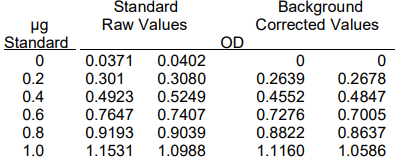
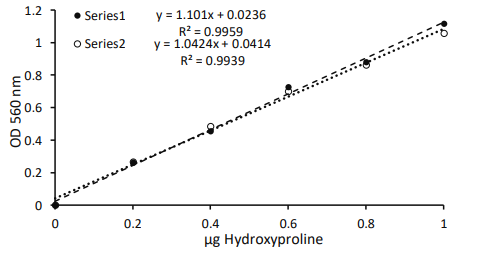
| Kit Summary | Hydroxyproline Assay kit • Detection method- Absorbance (560 nm) • Species reactivity- Mammalian • Applications- The assay is useful over the range of 0.1-2 μg. |
| Detection Method | Absorbance (OD 550-565 nm). |
| Species Reactivity Sample Type |
All Tissue hydrolysates, Serum, Urine |
| Applications | Estimation of hydroxyproline concentration in various biological samples |
| Kit Components | Oxidation Buffer 10 ml Chloramine T Concentrate 0.6 ml Acid/Isopropanol Solution 5 ml DMAB Concentrate 5 ml Hydroxyproline Standard (1 mg/ml) 0.1 ml Storage Conditions +4°C |
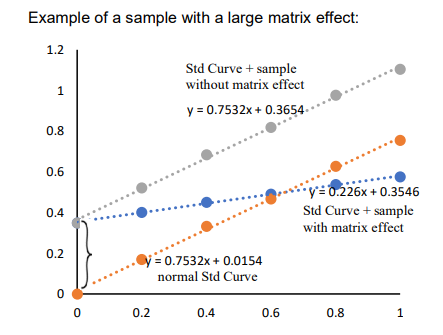
Note: Many metabolites and other chemicals can interfere significantly with a variety of reaction chemistries. For more precise
determinations, perform a standard curve in the absence and presence of a constant amount of sample. It’s not necessary to
run all six standards; use a minimum of 3 (0 – 10 – 20 µl) to verify that the OD response is linear with amount of analyte. The
slopes of the two std curves should be the same. The OD offset between them is attributable to the amount of analyte
(hydroxyproline in the current case) in the sample. If the two slopes are different, there is a matrix effect influencing the reaction
chemistry. In that case determine the OD difference between the 0 standards and apply the slope of the standard curve run in
the presence of sample to it.