熱啟動(Hot-Start ) DNA 聚合酶 | nanoTaq Hot-Start DNA Polymerase Bio-Helix 貨號DP001-0100
| 代理廠牌: |  |
| 原廠連結: | |
| 相關下載: |
熱啟動(Hot-Start ) DNA 聚合酶 nanoTaq Hot-Start DNA Polymerase| Bio-Helix 貨號DP001-0100
nano Taq Hot-Start DNA Polymerase
產品描述:
熱啟動聚合酶鏈式反應(Hot start PCR)是一種改良的聚合酶鏈式反應方法,主要用來避免操作過程中產生非特異性序列的擴增。Bio-Helix nanoTaq DNA 聚合酶(Bio-Helix nanoTaq DNA Polymerase , DP001-0100) 為“增強型”熱啟動酶 DNA 聚合酶之一,為您的研究目標提供便利和可靠性。 nanoTaq 採用“納米技術複合物設計”,是一項創新創造,不同於傳統的熱啟動酶製造方法。 nanoTaq 經驗證的功能包括在室溫下使用與傳統 Taq DNA 聚合酶相同的方案和循環條件進行反應,減少非特異性引物annealing,提高PCR產物產量,並可用於高達 5kb 的 PCR 產物。
- 專一性高,PCR產品可高於5kb
- 靈敏度高,用於 GC >50% 的目標
- 對humic acid干擾具有最佳耐受性。Hot-Start最佳選擇


nanoTaq DNA polymerase provides both specificity and yield.
| A | nanoTaq |
| B | Thermo DreamTaq |
| C | Thermo DreamTaq HS |
| D | Roche KAPA2G HS |
| E | Invitrogen Platinum HS |
Figure 1. Comparison of non-specific amplifying effects to major suppliers. (高專性表現)
All amplifications were performed in accordance with manufacturer’s instructions to amplify 320 to 941 bp amplicons from human genomic DNA. nanoTaq provided both higher specificity and yield products with least band shifting compared to other commercial antibody-mediated hot start polymerase.
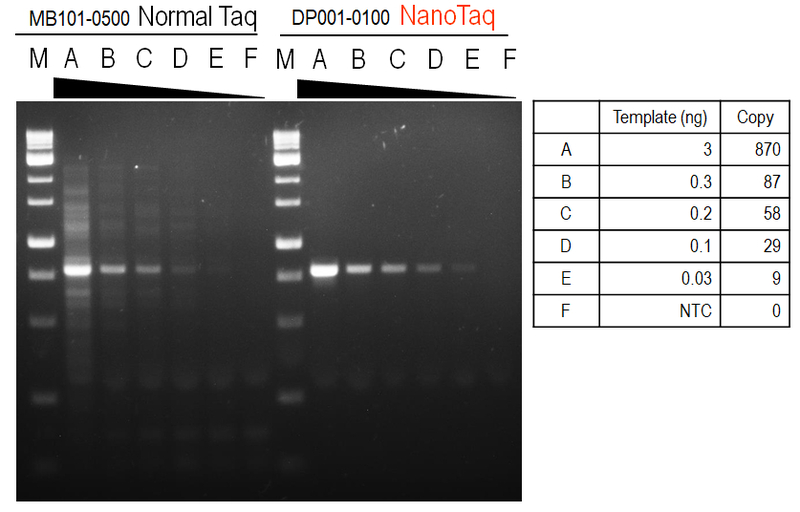
Figure 2. Sensitivity and reliable amplification from low amounts of input DNA.(靈敏度高)
Amplification of a 803 bp fragment from 3; 0.3; 0.2; 0.1; 0.03; 0(no template control) ng of human genomic DNA were amplified in 20μL PCR reactions using nanoTaq DNA Polymerase.
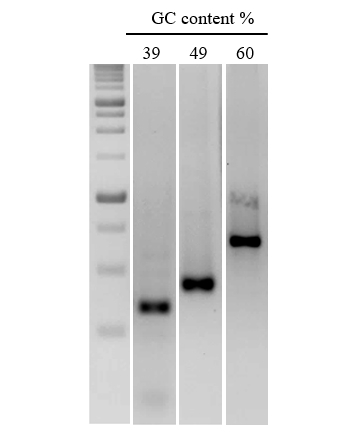
Figure 3. Efficient amplification of DNA sequences with a range of GC content. (有效用於 GC >50% 的目標DNA)
A series of DNA fragments of increasing GC content were amplified from human gDNA. nanoTaq Hot-Start DNA Polymerase was used for targets with >50% GC.
*Thermo DreamTaq, Thermo DreamTaq HS and Invitrogen Platinum HS are registered trademarks of Thermo ScientificTM PierceTM. Roche KAPA2G HS is a registered trademark of Merck. The trademark holders are not affiliated with Bio-Helix Co., Ltd. and do not endorse these products.
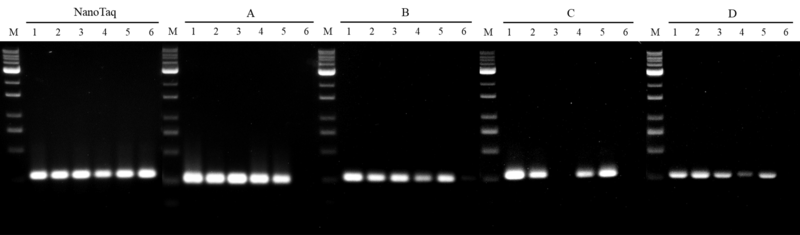
A. Thermo DreamTaq, Cat. EP0701
B. Thermo DreamTaq HS, Cat. EP1701
C. Roche KAPA2G HS, Cat. KK5523
D. Invitrogen Platinum HS, Cat. 10966-018
Figure 4. Inhibitor resistance on nanoTaq DNA polymerase
A 280 bp human genomic DNA target was conducted to compare with four leading competing DNA polymerases. All amplifications were performed in accordance with manufacturer’s instructions where the mixtures contain:
1. no inhibitor control,
2. bile salts with final concentration of 0.5 mg/mL,
3. heparin with final concentration of 0.5 unit/mL,
4. sodium citrate with final concentration of 150 μg/mL,
5. hemin with final concentration of 0.1 μg/mL and
6. humic acid with final concentration of 1 μg/mL.
The results show that nanoTaq has the best tolerance with the humic acid interference, when compared with major suppliers of the hot-start DNA polymerase.
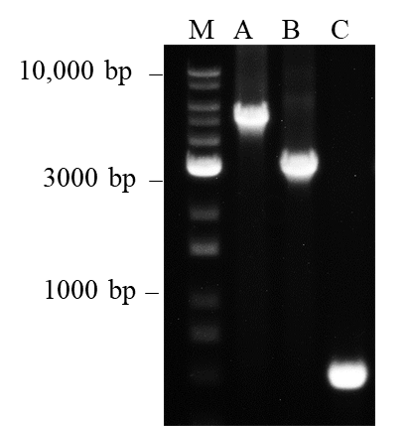
Figure 5. Amplification of long target DNA fragments
It is generally known that Taq DNA polymerase exhibits difficulty amplifying DNA fragment sizes larger than 1 kb. This is probably due to the polymerase’s error-prone amplification process which reduces the efficiency in amplifying longer target sizes. However, we have shown that nanoTaq is capable of amplifying Lane M: 1Kb plus DNA Ladder RTU (DM015-R500), Lane A: 5 kb, Lane B: 3 kb and Lane C: 0.5 kb Lambda DNA fragment sizes under the 3-min extension time at 72°C. Therefore, nanoTaq shows the optimal performance in applications with long PCR fragments.
產品特徵:
► High tolerance aganist various reaction inhibitors
► Reduce nonspecific primer annealing
► Plays in efficient PCR amplification of GC-rich sequences
► Using the same protocol and cycling conditions as conventional Taq DNA polymerases
產品反應設置:
1. For each 20 μl reaction, assemble the following in a 0.2 ml PCR tube on ice just prior to use:
| Volume | Final Conc. | |
| DNA template | – μl | 3 ng |
| Forward primer, 5-10 μM | – μl | 0.1-0.5 μM |
| Reverse primer, 5-10 μM | – μl | 0.1-0.5 μM |
| dNTP Mix (10 mM each dATP, dCTP, dGTP, dTTP) | – μl | 200 µM |
| 10X PCR buffer | 2 μl | – |
| nanoTaq Hot-Start DNA Polymerase | -1 μl | – |
| PCR Grade Water | Add to 20 μl | – |
| Total volume | 20 μl | – |
2. Mix gently. If necessary, centrifuge briefly and cap tubes.
3. Place them into Thermocycler and process for 30-35 cycles as follows:
| Initial Denaturation | 3 min at 95°C | |
| Denaturation | 30 sec | 30-35 cycles |
| Annealing | 30 sec at the proper annealing temperature | |
| Extension | 1 min at 72°C | |
| Final extension | 5 min at 72°C |
Note: Optimal conditions for amplification will vary depending on the primers and thermal cycler used. It may be necessary to optimize the system for individual primers, template, and thermal cycler.
* Template:
Purified high quality DNA is needed for a success PCR reaction. The final concentration of cDNA template please refer to “Reaction Setup”.
* Storage Buffer:
The enzyme is supplied in a storage buffer consisting of 20 mM Tris-HCl (pH 8.0), 0.1 mM EDTA, 1 mM DTT, 50% (v/v) glycerol, and 1% Triton X-100.
* Unit Definition:
One unit is defined as the amount of enzyme that will catalyze the incorporation of 10 nmol of dNTP into acid- insoluble form in 30 min at 74°C in a reaction containing 25 mM TAPS (tris-[hydroxymethyl]-methyl-amino- propane-sulfonic acid, sodium salt), pH 9.3 at 25°C, 50 mM KCl, 2 mM MgCl2, 1 mM β-mercaptoethanol, 0.2 mM dATP, dGTP, and dTTP, 0.1 μM [α-32P] dCTP, and activated salmon sperm DNA.
聚合酶鏈反應 (Polymerase Chain Reaction, PCR)/DNA凝膠電泳
PCR反應->瓊脂膠體粉末配製->DNA凝膠電泳(agarose gel electrophoresis)->核酸染色->在電泳完成後藉由藍光觀察箱激發看到不同大小的DNA片段。

聚合酶鏈反應 (Polymerase Chain Reaction, PCR) 是一種分子技術(molecular technology),由諾貝爾獎獲得者 Kary Mullis 在 1980 年代開發,可以體外(in vivo) 快速且廉價地擴增 DNA 片段(DNA fragments)(1)。它已成為遺傳( genetic )和分子研究(molecular research)的基本工具,因為 DNA 實驗(DNA experimentation)通常需要大量的目標 DNA (2)(3)。一些依賴 PCR 技術(PCR technology)的應用包括 DNA 測序(DNA sequencing)(例如人類基因組計劃,Human Genome Project)、DNA 指紋識別(DNA fingerprinting)、法醫學(forensics)、細菌(bacteria)或病毒( viruses)檢測(尤其是 AIDS)和遺傳性疾病(hereditary disease)的診斷 (4)(5)。由於能夠從少量核酸(nucleic acid)生成大量 DNA,PCR 是一種非常有效的 DNA 擴增方法(amplify DNA ),因此有時被稱為“分子復印(molecular photocopying)”(2)(3)(6)。
為了檢查是否擴增了正確的目標 DNA 片段,凝膠電泳(gel electrophoresis)是檢查擴增產物(amplified products)分子大小(以 bp 為單位)的快速方法。流程如下:PCR反應產物,經微量分注器取少量Loading至配製好的瓊脂膠體, 放置水平電泳槽,經凝膠電泳(gel electrophoresis)後,電泳完的瓊脂膠體, 結合DNA核酸染劑,在藍光觀察箱激發下,觀察不同大小的DNA片段。經由擴增的 PCR 產物的大小是通過將其與DNA Ladder 進行比較來估計的,DNA Ladder是一種分子量標記,其中包含已知大小的 DNA 片段。

許多因素會干擾 PCR 反應。有些易於優化(例如熱循環條件和 Mg 2+濃度),而另一些則操作起來比較棘手,需要積累經驗才能解決(例如引物設計和 PCR 緩衝液成分/添加劑)。一般來說,PCR 中的重要因素包括 DNA 模板、DNA 聚合酶、引物設計、緩衝液成分、添加劑和抑製劑以及熱循環條件 (6)。或選擇2XPCR混合液進行 PCR 反應,2X PCR 混合液 (2X PCR SuperMix, MB200-P100 )具最佳之Mg ++、dNTP和重組Taq DNA聚合酶的混合物。僅需加入 template DNA、primer 混合液即可開始進行 PCR 反應。
瓊脂膠體的製備:取適量瓊脂膠體粉末放入緩衝液(常用的是TBE緩衝液)中,以微波加熱至完全溶解,混合均勻後,冷卻至約50℃,倒入插有齒狀模型之鑄模中,靜置等待膠體凝固後,再取下齒狀模型。取出已完全凝固的膠體,置於電泳槽內,並加入緩衝液至覆蓋膠體。

PCR混合液 | 100bp-10kb DNA Ladder | 瓊脂膠體粉Agarose | DNA核酸染劑


聚合酶鍊式反應 (PCR) 是 Kary Mullis 在 1980 年代開發的革命性方法 [1],為分子生物學中最強大的技術之一。序列特異性引子、熱穩定 DNA 聚合酶和熱循環將 DNA 或 cDNA 模板中的特定序列從少量擴增到數千到百萬倍。 20-40 次重複的加熱和冷卻循環(稱為熱循環/thermal cycling),通過酶促反應促進 DNA 複製(DNA replication)。目標序列的數量隨著每個循環加倍,指數擴增。40 次重複的 PCR 熱循環將從模板的單個拷貝生成 1,099,511,627,776 個 DNA 拷貝。
In a nutshell, PCR is essentially a series of 20-40 repeated cycles of heating and cooling (called thermal cycling) that facilitate DNA replication through enzymatic reactions. The amount of target sequence doubles with each cycle which leads to an exponential amplification represented by 2(# of cycles). Therefore, a PCR thermal cycling of 40 repeats will generate 1,099,511,627,776 copies of DNA from a single copy of the template. The function and purpose of each step in a PCR Reaction are discussed below (Figure 1):

Figure 1 – How Polymerase Chain Reaction works: 1) Denaturation: the reaction is heated to 94–98 °C for 20–30 seconds to break the hydrogen bonds between the strands. 2) Annealing: the reaction temperature is lowered to 50-65 °C for 20-40 seconds to allow primers to anneal to the template strands. 3) Elongation: the temperature is increased (the optimal temperature is dependent on the DNA Polymerase used e.g. 72-78 °C for Taq Polymerase) to allow for the addition of dNTPs. The amount of target sequence doubles with each thermal cycle which leads to an exponential amplification represented by 2(# of cycles)
起始反應( Initialization)
將反應加熱至 94–96°C(如果使用極耐熱的 DNA 聚合酶,則加熱至 98°C)2-10 分鐘。該步驟激活反應中的 DNA 聚合酶和試劑,並使混合物中的其他污染物(如果有)變性。在菌落篩選等應用中,可直接使用少量細胞作為模板。此初始化步驟將裂解細胞以釋放 DNA 並使其他細胞蛋白質(包括 DNase)變性。如果在 PCR 期間使用化學品或抗體(例如 BlasTaq™ HotStart DNA 聚合酶),則必須執行此步驟以熱激活酶。
變性(Denaturation)
將反應加熱至 94–98°C 並保持 20–30 秒。這是熱循環(thermal cycling)的第一步。雙鏈 DNA(Double-stranded DNA) 在此步驟中變性,因為雙鏈之間的氫鍵(hydrogen bonds)因高溫而斷裂,這一過程也稱為 DNA 熔化(DNA melting)。
鏈合(Annealing)
引子(Primers )是可以與 DNA 模板(DNA template)的特定序列(specific sequences)結合以指導 DNA 聚合酶複製的寡核苷酸( oligonucleotides )。為使引物( primers )與單鏈 DNA 模板 annealing,通常將反應溫度降至 50-65°C,持續 20-40 秒。Annealing的最佳溫度取決於引物的解鏈溫度 (T m ):DNA 雙鏈體(DNA duplex)的一半解離成單鏈的溫度。Annealing溫度設置過高引物不能與模板Annealing,Annealing溫度過低可能發生非特異性引物(導致非特異性擴增)。因此,理想的Annealing溫度通常比 Tm 低 3-5° C的引物((Primers ),足夠高以進行特異性引子(Primers ) )Annealing,但又足夠低以允許有效的引子(Primers )。反應混合物中的引子(Primers )濃度通常遠高於 DNA 模板的濃度,因此引子(Primers )-模板雜交比模板鏈的重新Annealing更受青睞。一旦引子(Primers )與模板Annealing,DNA 聚合酶就可以開始將 dNTP 結合到模板上。
延伸/伸長(Extension/Elongation)
在此步驟中,DNA 聚合酶與引子(Primers )/模板(template)複合物結合,並開始在合成鏈(synthesizing strand)上以 5′ 到 3′ 的方向摻入 dNTP。這會產生一條新合成的與模板鏈(template strand)互補的 DNA 鏈。對於不同的 DNA 聚合酶( DNA polymerases),延伸/延長(extension/elongation )的最佳溫度不同。Taq DNA 聚合酶(DNA polymerases)(耐熱)的理想工作溫度為 72-78°C。延伸的持續時間取決於原始模板(又名擴增子)的長度和 DNA 聚合酶的速度。典型的 DNA 聚合酶( Typical DNA polymerases)在其最佳溫度範圍內以 1-1.5kb/min 的速度聚合。
最終伸長率(Final Elongation)
在最後一個延伸循環中,將反應混合物保持在 72-78°C(大多數聚合酶的最佳工作溫度)5-15 分鐘。此步驟確保任何剩餘的單鏈 DNA 在最後一個 PCR 循環後完全延伸。
最後保持(Final Hold)
將溫度降低至 4-15°C 並持續無限長的時間以短期儲存反應混合物 (6)。