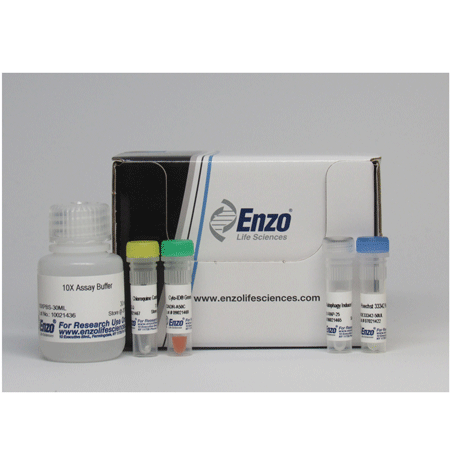
CYTO-ID ®自噬檢測試劑盒 | Autophagy detection kit貨號ENZ-51031-K200
| 代理廠牌: | |
| 原廠連結: | |
| 相關下載: |
自噬(Autophagy )檢測 | Autophagy Cellular Analysis Kits
CYTO-ID ®自噬檢測試劑盒 | Autophagy detection kit貨號ENZ-51031-K200
一種用於監測活細胞自噬的非轉染定量分析
自噬(Autophagy)是一種應激誘導的保護機制(stress-induced protective mechanism)。在基礎條件下不太活躍,真核細胞在受到某些不利條件(如營養耗盡和化學或環境壓力)時通過溶酶體介導(lysosome-mediated)的細胞內容物的大量降解來利用該機制。自噬活性(autophagic activity)增加在癌症(cancer)、神經變性(neurodegeneration)、心血管疾病( cardiovascular disease)和糖尿病( diabetes)的病理學中的作用已得到廣泛認可和普遍研究。如果溶酶體功能( lysosomal function)受到抑制,可以通過自噬小泡的增強積累來觀察自噬通量的誘導,從而阻止這些小泡的去除。
Enzo Life Sciences CYTO-ID ®自噬檢測試劑盒(CYTO-ID® Autophagy Detection Kit , ENZ-51031-K200)使用一種選擇性標記積累的自噬泡的新型染料測量自噬泡(autophagic vacuoles)並監測溶酶體抑制活細胞中的自噬流(autophagic flux )。488nm 可激發的綠色染料(488nm-excitable green dye )已通過鑑定可滴定功能部分進行了優化,這些部分允許對溶酶體的染色最少,同時在摻入前自噬體(pre-autophagosomes)、自噬體( autophagosomes)和自噬溶酶體(自噬溶酶體)時表現出明亮的螢光。該試劑盒還包括用於核染色的 Hoechst 33342 染料、自噬誘導劑-雷帕黴素(Rapamycin)和溶酶體抑制劑-氯喹(Chloroquine)。
作用機制 (Mechanism of Action & Autophagy Pathway)
CYTO-ID ®自噬檢測試劑盒是 CELLESTIAL ®產品線、試劑和檢測試劑盒的成員,其中包含螢光分子探針,這些探針已針對活細胞分析應用進行了廣泛的基準測試。該探針是一種陽離子兩親性示踪劑 (CAT) 染料,它以與誘導磷脂沉積症的藥物類似的方式快速分配到細胞中。仔細選擇染料上的可滴定功能部分可防止其在溶酶體中積累,但能夠標記與自噬途徑相關的液泡。


- 快速,無需轉染
- 使用已知的自噬活性抑制劑和激活劑驗證的方案
- 選擇性和全面的染色可以區分自噬通量和自噬溶酶體積累
- 溶酶體染色可忽略不計,降低了其他染料所見的背景
- 促進自噬激活劑和抑製劑的高通量篩選
快速,無需轉染 (Profile Autophagy Without Transfection)

Visualization of Autophagic Accumulation and Autophagic Flux


無需轉染即可對自噬泡進行省時、快速和全面的標記。為了展示 CYTO-ID ® Green 檢測試劑的優勢,首先用 RFP-LC3 表達載體轉染 HeLa 細胞,用 10 µM Tamoxifen 處理過夜,然後用 CYTO-ID ® Green 檢測試劑染色。與基於過夜轉染的測定不同,CYTO-ID ® Green 檢測試劑方法可在 15-30 分鐘內標記 100% 的細胞。圖 A:綠色信號表示自噬小泡的 CYTO-ID ®綠色染色;圖 B:RFP-LC3 在成功轉染的細胞子集中的表達(紅色);面板 C:合成圖像,顯示 CYTO-ID ®綠色染料標記的囊泡與自噬體的特異性標記物 LC3 共定位。


Product Literature References
3,4,5-O-tricaffeoylquinic acid with anti-radiation activity suppresses LPS-induced NLRP3 inflammasome activation via autophagy in THP-1 macrophages: J. Liu, et al.; Mol. Immunol. 147, 187 (2022), Abstract;
A peptide interfering with the dimerization of oncogenic KITENIN protein and its stability suppresses colorectal tumour progression: S.J. Kim et al.; Clin. Transl. Med. 12, e871 (2022), Abstract;
Activated amino acid response pathway generates apatinib resistance by reprograming glutamine metabolism in non-small-cell lung cancer: X. Zhou, et al.; Cell Death Dis. 13, 636 (2022), Abstract;
Air Plasma-Activated Medium Evokes a Death-Associated Perinuclear Mitochondrial Clustering: M. Suzuki-Karasaki, et al.; Int. J. Mol. Sci. 23, 1124 (2022), Abstract;
Alcohol Metabolism Enriches Squamous Cell Carcinoma Cancer Stem Cells That Survive Oxidative Stress via Autophagy: M. Shimonosono, et al.; Biomolecules 11, 1479 (2022), Abstract;
Asiatic acid from Cyclocarya paliurus regulates the autophagy-lysosome system via directly inhibiting TGF-β type I receptor and ameliorates diabetic nephropathy fibrosis: X.X. Zhang, et al.; Food Funct. 13, 5536 (2022), Abstract;
Autophagy induced by taurolidine protects against polymicrobial sepsis by promoting both host resistance and disease tolerance: J. Huang, et al.; PNAS 119, e2121244119 (2022), Abstract;
BCL2 inhibitor ABT-199 and BCL2L1 inhibitor WEHI-539 coordinately promote NOXA-mediated degradation of MCL1 in human leukemia cells: J.T. Chiou, et al.; Chem. Biol. Interact. 361, 109978 (2022), Abstract;
Celastrol upregulated ATG7 triggers autophagy via targeting Nur77 in colorectal cancer: W. Zhang, et al.; Phytomedicine 104, 154280 (2022), Abstract;
Cellular Effects of Cyclodextrins: Studies on HeLa Cells: Á. Rusznyák, et al.; Molecules 27, 1589 (2022), Abstract;
CNS serotonin content mediating food deprivation-enhanced learning is regulated by hemolymph tryptophan concentration and autophagic flux in the pond snail: Y. Totani, et al.; Nutr. Neurosci. (2022), Abstract;
Combined Levo-tetrahydropalmatine and diphenyleneiodonium chloride enhances antitumor activity in hepatocellular carcinoma: X. Yin, et al.; Pharmacol. Res. 179, 106219 (2022), Abstract;
Gallium(III) Complex with Cloxyquin Ligands Induces Ferroptosis in Cancer Cells and Is a Potent Agent against Both Differentiated and Tumorigenic Cancer Stem Rhabdomyosarcoma Cells: M. Hreusova, et al.; Bioinorg. Chem. Appl. 2022, 3095749 (2022), Abstract;
HIF-1α/FOXO1 axis regulated autophagy is protective for β cell survival under hypoxia in human islets: R. Liang, et al.; Biochim. Biophys. Acta Mol. Basis Dis. 1868, 166356 (2022), Abstract;
Identification of distinct slow mode of reversible adaptation of pancreatic ductal adenocarcinoma to the prolonged acidic pH microenvironment: T.C. Wu, et al.; J. Exp. Clin. Cancer Res. 41, 137 (2022), Abstract;
Inhibition of B-cell lymphoma 2 family proteins alters optical redox ratio, mitochondrial polarization, and cell energetics independent of cell state: A.A. Gillette, et al.; J. Biomed. Opt. 27, 056505 (2022), Abstract;
Integrative analysis of the miRNA-mRNA regulation network in hemocytes of Penaeus vannamei following Vibrio alginolyticus infection: F. Wang, et al.; Dev. Comp. Immunol. 131, 104390 (2022), Abstract;
Magnesium Homeostasis in Myogenic Differentiation – A Focus on the Regulation of TRPM7, MagT1 and SLC41A1 Transporters: M. Zocchi, et al.; Int. J. Mol. Sci. 23, 1658 (2022), Abstract;
miR-23b-3p Modulating Cytoprotective Autophagy and Glutamine Addiction in Sorafenib Resistant HepG2, a Hepatocellular Carcinoma Cell Line: R. Kaur, et al.; Genes 13, 1375 (2022), Abstract;
Nanoparticle formulation of the fusion protein virus like particles of respiratory syncytial virus stimulates enhanced in vitro antigen presentation and autophagy: I. Menon, et al.; Int. J. Pharm. 623, 121919 (2022), Abstract;
NEDD4L binds the proteasome and promotes autophagy and bortezomib sensitivity in multiple myeloma: X. Huang, et al.; Cell Death Dis. 13, 197 (2022), Abstract;
Nigrosporins B, a Potential Anti-Cervical Cancer Agent, Induces Apoptosis and Protective Autophagy in Human Cervical Cancer Ca Ski Cells Mediated by PI3K/AKT/mTOR Signaling Pathway: J. Zhang, et al.; Molecules 27, 2431 (2022), Abstract;
PHF20 is crucial for epigenetic control of starvation-induced autophagy through enhancer activation: S.W. Park, et al.; Nucleic Acids Res. 50, 7856 (2022), Abstract;
Protective autophagy decreases lorlatinib cytotoxicity through Foxo3a-dependent inhibition of apoptosis in NSCLC: C. Lu, et al.; Cell Death Discov. 8, 221 (2022), Abstract;
Regulatory Effects of Astragaloside IV on Hyperglycemia-Induced Mitophagy in Schwann Cells: X. Wei, et al.; Evid. Based Complement. Alternat. Med. 2022, 7864308 (2022), Abstract;
Siah-1-interacting protein regulates mutated huntingtin protein aggregation in Huntington’s disease models: E. Latoszek, et al.; Cell Biosci. 12, 34 (2022), Abstract;
Spautin-1 inhibits mitochondrial complex I and leads to suppression of the unfolded protein response and cell survival during glucose starvation: K. Kunimasa, et al.; Sci. Rep. 12, 11533 (2022), Abstract;
The preventive effect of loganin on oxidative stress-induced cellular damage in human keratinocyte HaCaT cells: C. Park, et al.; Biosci. Trends 16, 291 (2022), Abstract;
